Artist: Liliana Zeic,
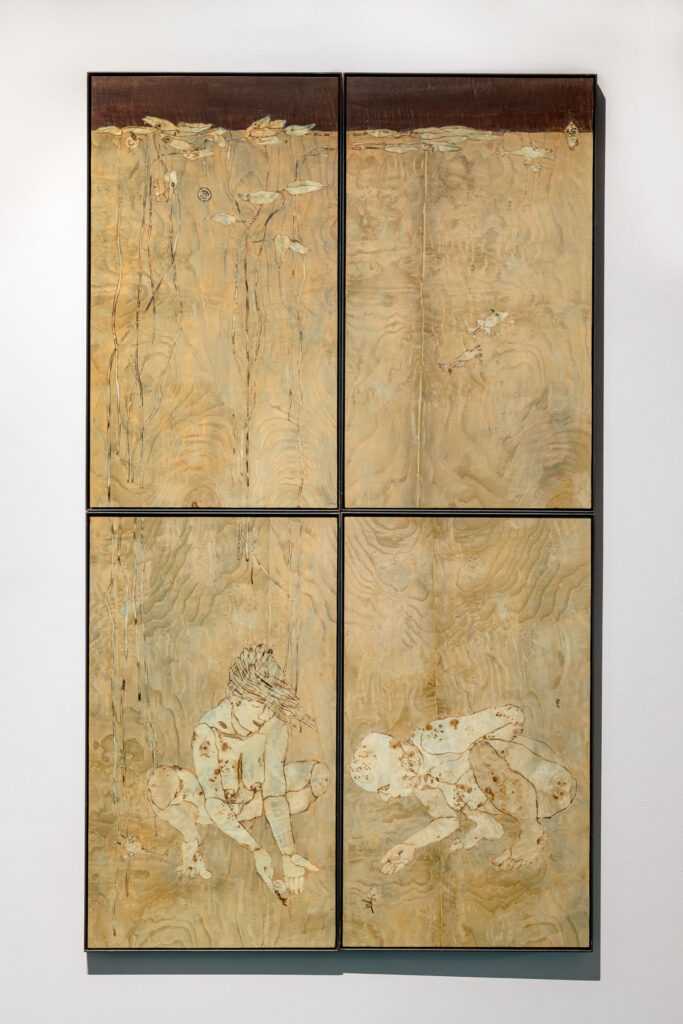
Title: Floating pondweed and women who breed liver flukes on snails, Intarsia, poplar burl, ash burl, Indian apple burl, steel, (4 parts), 2025.
During my first encounter with this object, my attention was immediately drawn to the human figures—two naked squatting women. Their bodies lean forward over a pair of snails. Their relaxed faces, open hands, and legs spread wide suggest a lack of shame and a state of deep relaxation. Squatting is a natural resting position, now largely absent from contemporary life.
The World Turned Upside Down
The vertical lines accompanying the figures, together with the direction of the frogs’ movement, guide the viewer’s gaze upward. A narrow, dark strip of horizon cuts off the bright, underwater section of the composition; paradoxically, the terrestrial world is plunged into darkness and almost entirely ignored. This simple compositional gesture directs our attention toward what is hidden and submerged, focusing on the perspective of those from below.
Biology, Politics, and the Metaphysics of Rhizomes
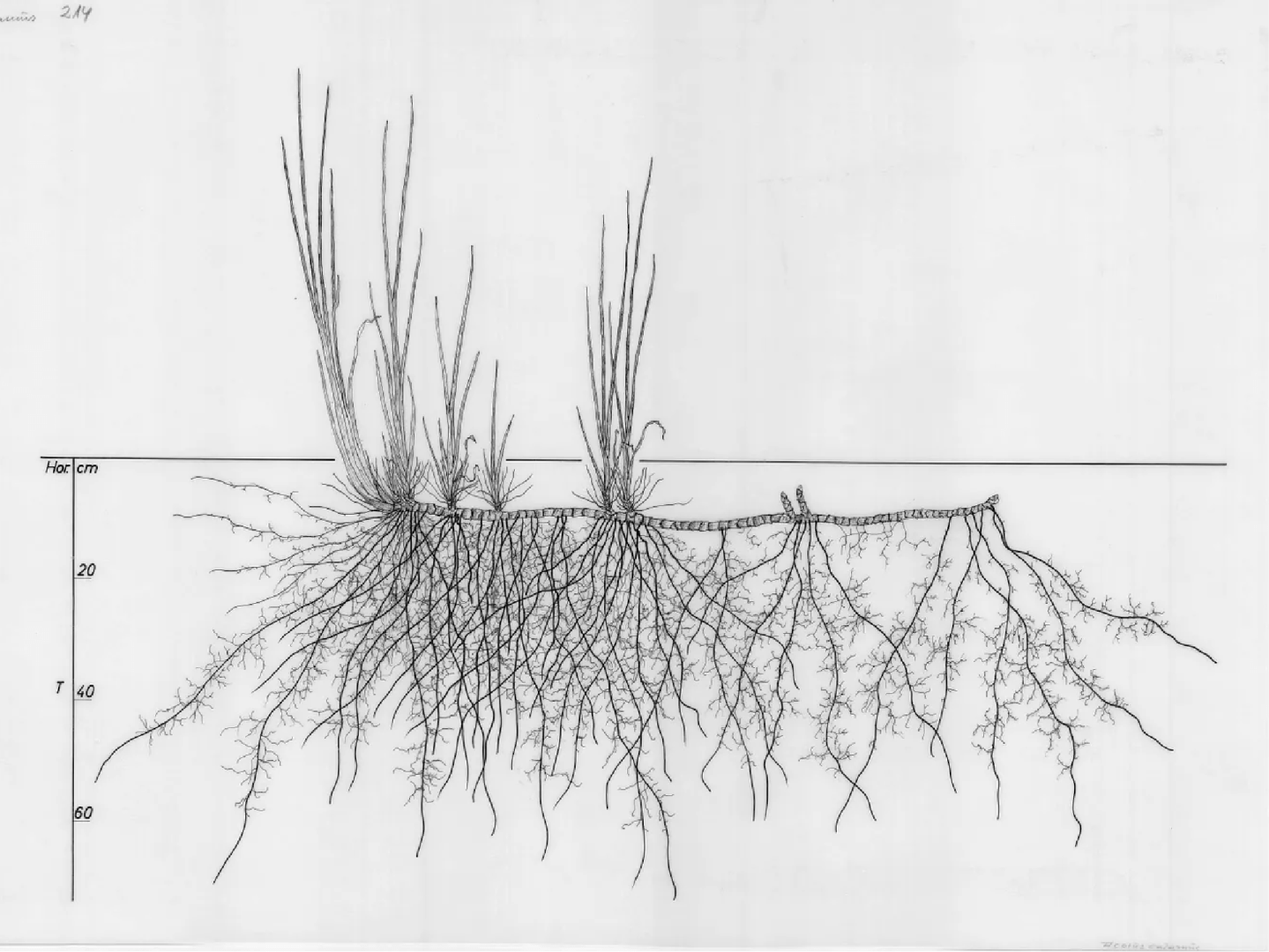
Near the water’s surface and floating upon it are the leaves of pondweed. Its stems—rendered here as vertical lines—can reach several meters in height. Although floating pondweed is capable of both sexual and asexual reproduction, it is asexual reproduction that remains its dominant strategy. This occurs through the production of long, creeping rhizomes that spread horizontally through the mud at the bottom. From these rhizomes grow new shoots that— even when separated from the parent structure—are capable of continuing life independently. Even a torn or partially eaten fragment retains the ability to continue growing. This mode of reproduction entails the disappearance of a clearly defined center: there is no trunk, axis, or single point of origin, as in the case of trees.
This characteristic of rhizomatic plants inspired philosopher Gilles Deleuze and psychoanalyst Félix Guattari to formulate the concept of a non-hierarchical model of existence—the rhizome. Rhizomatic reproduction—dispersed, without a single center, based on horizontal connections—embodies a mode of thought in which meaning is not organized around one source and possesses neither beginning nor end. In this light, pondweed stands as a politico-philosophical parable of an alternative to centralized power and knowledge.
Is a Parasite Worthy of Care?
Another species referenced by the title of the work is the liver fluke—a parasite inhabiting the bile ducts of many mammalian species, including humans. Its life cycle includes several larval stages as well as an intermediate host—air-breathing freshwater snails—seen in the artwork.
Decoding the enigmatic title of the work and understanding what the liver fluke is, as well as realizing that the women depicted are cultivating parasites, initially provoked a strong reaction in me: disgust and resistance, mixed with confusion. After some time, these feelings gave way to curiosity. Why do the women in the image nurse parasites? Instead of rejection and hostility, they respond with care, nurturing what is commonly regarded as pathogenic, repulsive, or even evil. This surprising montage—the gesture of care toward the repulsive—reminded me of the compassion that lesbians showed to gay men infected with HIV/AIDS.
Care as Rebellion
This was an act of remarkable solidarity at a time when gay men were stigmatized as mentally ill and seen as a “plague,” both morally and physically. During the HIV epidemic, critical blood shortages arose as infected people often needed transfusions and the U.S. banned men who have sex with men from donating. In response, groups of lesbians—most famously the San Diego Blood Sisters—organized drives, ensuring their donations reached patients with HIV/AIDS, stepping in where medical and social institutions failed.
Radical Compassion
Once again, we encounter a reversal of perspective. Care does not appear here as an innocent or neutral practice—it functions as a form of rebellion. This constitutes a literal inversion of the logic of fascism and capitalism, systems that often employ dehumanizing language, comparing minorities (ethnic, religious, sexual, and others) as well as those deemed “unproductive”—the homeless, the unemployed, the disabled—to parasites and pest. Analogies to diseases and parasites have always been intended to create the impression that given groups “contaminate” society and that exclusion and violence against them is a “natural” hygienic, biological and moral necessity. In this context, the gesture of care toward what is stigmatized as diseased, repulsive, and disposable becomes a radically anti-fascist and anti-capitalist political act.
Eco-Queer Mythology of Resistance

Świteź—the Sunken City
Another layer of the work reveals its pagan-historical entanglement. The object belongs to the Świteź cycle and was inspired by Adam Mickiewicz’s ballad of the same name, based on a folk legend. According to the legend, the men of the settlement left the city to fight the Tsar’s invaders, and during their absence an attack took place. The event, described as a miracle, saved the defenseless inhabitants from a cruel fate: the city sank, forming a lake, and its inhabitants—primarily women and children—were transformed into poisonous plants. The women depicted in the work are precisely these inhabitants of the submerged city. They fight back not through direct confrontation, but through seduction: enchanted by the beauty of the plants and unaware of their toxicity, the aggressors begin to pluck them—and perish.

Becoming-Plant
The transformed figures literally become part of nature—both on the level of narrative and materiality. The intarsia technique used by Zeic involves inlaying surfaces with various pieces of wood (and sometimes other materials). Zeic employs the natural texture of wood to convey both the movement of water and the transformation of the figures. This metamorphosis evokes the myth of Daphne and Apollo, in which transformation into a plant becomes also a strategy of survival.
Pre-Christian Imagination as a Source of Resistance
Adam Mickiewicz’s ballad Świteź was written during the period of the partitions of Poland and can be read as an anti-colonial narrative. Mickiewicz restores the power of local, pre-Christian imagination, mobilizing it as resistance against the external authority of the Church, occupying forces (Prussia, Russia, and Austria), and the reductionist discourse of science.
Similarly, Liliana’s work invites the viewer to listen to the unruly spirits of pre-Christian worlds. Both artists explore alternative modes of being and knowing, returning the human to the realm of nature and mystical.
This engagement with the past gains added weight amid contemporary events. The work was created during escalating tensions between Poland and Russia, intertwining historical trauma with the ongoing war in Ukraine and the looming threat of Russian imperial ambitions.
The work functions as an anti-colonial narrative, drawing on the legend of a community resisting invaders. Its power emerges through a fusion with nature, reflecting ecological concerns while simultaneously challenging anthropocentrism and hierarchies of beings. By transforming humans into plants, the work blurs the boundaries between body and environment, creating an eco-queer mythology that celebrates alternative perspectives from below.