For Jean


The trigger for the creation of this work was unresolved grief following the loss of my friend Juan Cueto. His family buried him according to their own beliefs and against his own—erasing his queer life, partner, and community. This double denial—as if he had not only died, but never existed—left me with a profound sense of injustice and the question: how can we mourn an indecent indecently? Traditional funeral rituals enforce solemnity, stripping the body of its sexual history. This desexualization is not neutral—it is a tool of moral control, an act of erasing queer existence.
But can we remember the dead and still honor them as sexual beings?
As Judith Butler argues in Melancholy Gender, heteronormative structures require the erasure of queer bonds—a forced oblivion in which the lost lover, unacceptable desires, and unlivable life are relegated to the realm of the unspeakable.
“I never loved him, I never lost him.”
A Camp Reinterpretation of Memento Mori
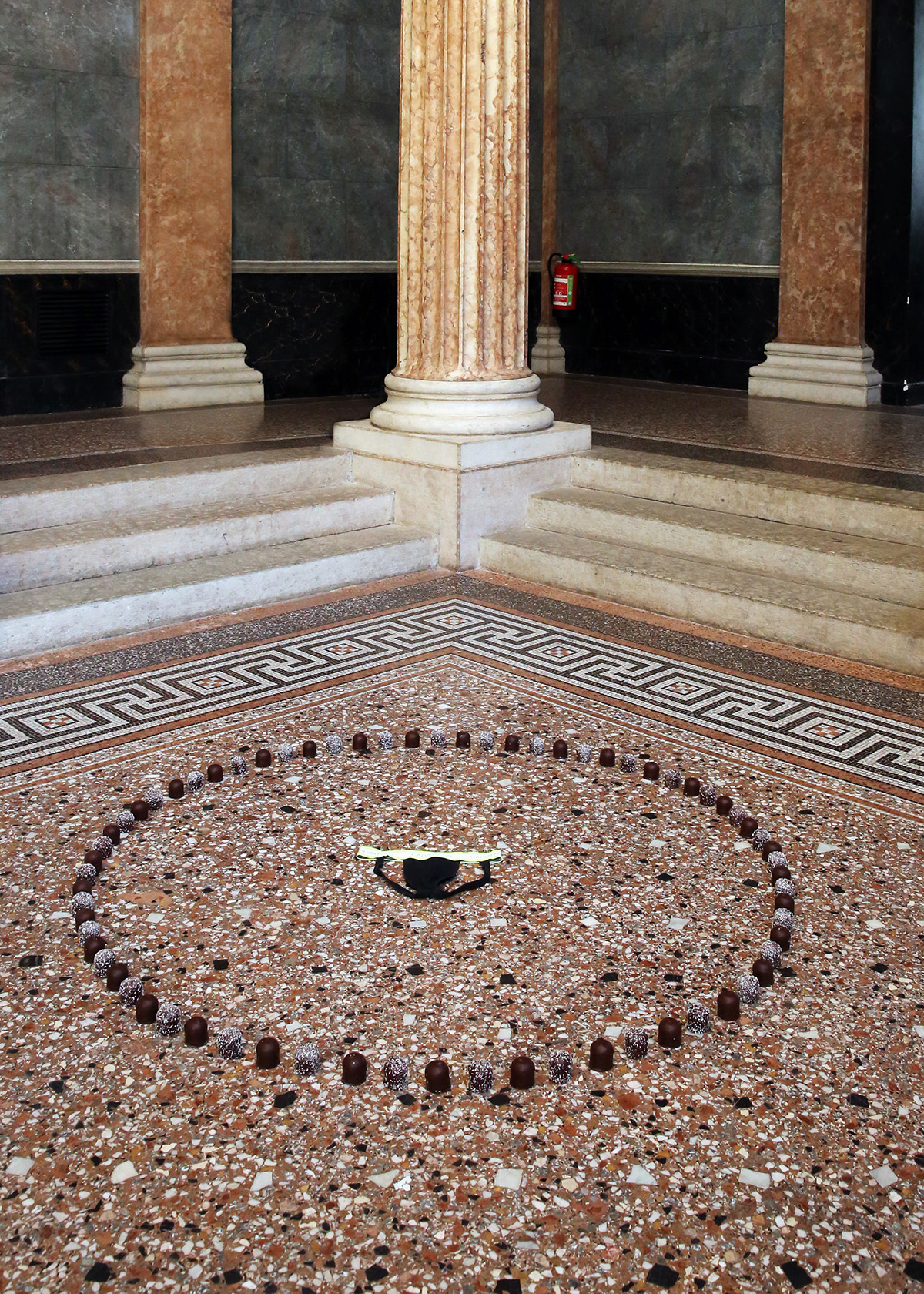
The installation consists of a jockstrap encircled by Schwedenbomben—fragile sweets whose delicate shells crack at the slightest touch. Their vulnerability echoes the vanitas tradition, particularly in Baroque still lifes, where desserts symbolize the fleeting nature of life. As mass-produced, inexpensive confections, Schwedenbomben introduce irony and camp aesthetics rooted in queer culture, fusing the memento mori with exaggeration, humor, and artifice. In this context, Schwedenbomben become a camp reinterpretation of memento mori.

Oil on panel. 43.7 x 68.2 cm
Museo Nacional Thyssen-Bornemisza, Madrid
The desert in Baroque still life functions as a meditation on the impermanence of life and the futility of earthly pursuits.
Pleasure over Practicality
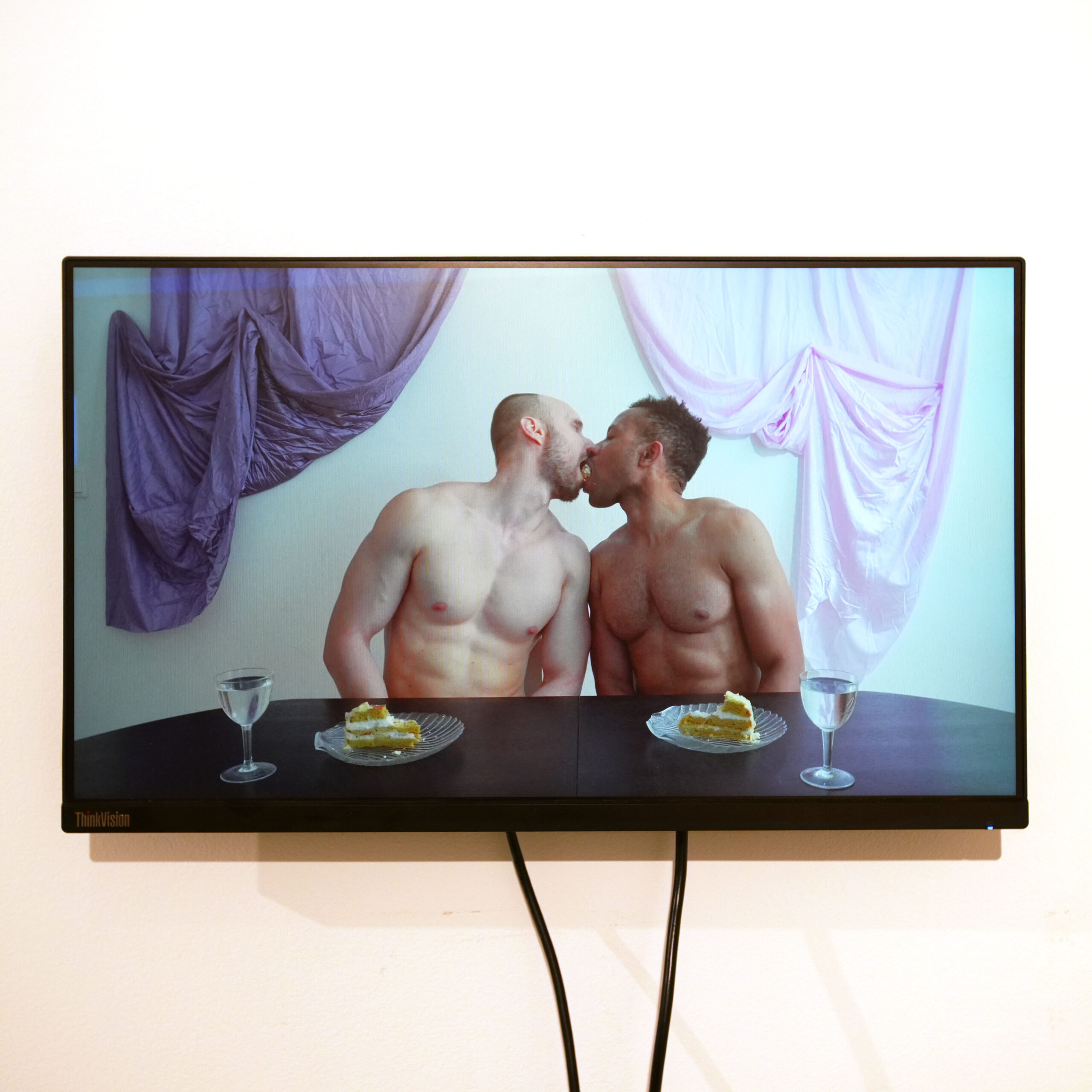
Both the jockstrap and the Swedish bomb are made primarily for pleasure. Sweets packed with sugar offer no real nutritional value. Instead, their taste, appearance, and smell are carefully designed to maximize enjoyment. Similarly, the jockstrap barely covers the skin, functioning less as a practical garment and more as a means to enhance the body’s sexual allure. Thus, in both cases, function gives way to sensation, and utility is replaced by the pursuit of pleasure.
A Queer Ritual
But where is the body? Is it a summoning, an offering, or both?
The jockstrap, lying on the ground, evokes the absence of the body: a trace
of someone once present, desired, and lost. Paired with the sweets, it recalls food offerings for the dead found across cultures—from Día de Muertos and Slavic Dziady to the Hungry Ghost Festival—rituals that seek to bridge the gap between the living and the dead.

Is it a Summoning?
Meanwhile, the circle suggests a protective barrier—separating the summoner from the unknown forces they seek to invoke. In Western esoteric tradition, materials like salt, flour, or chalk were used to form magic circles. Yet here, the Schwedenbomben are used, introducing a humorous twist—a sprinkle of absurdity.
Echoing the ancient stone circles, the piece draws on the traditions of Land Art and Arte Povera from a queer perspective.
These spiritual aspects of the installation also resonate with deeper themes of collective mourning and personal loss within the queer community. So, who is this queer ritual for?
HIV/AIDS Epidemics and Mental Health Crisis
In 1991, Felix González-Torres placed a pile of wrapped candies in a gallery to commemorate the loss of his close friend to AIDS — Untitled” (Portrait of Ross in L.A.). Visitors were free to take candies away. The gradually diminishing pile of candies mirrored the deterioration and disappearance of patience consumed by the disease.

Photo by Spangineer.

Queer erasure is an ongoing practice: the National Portrait Gallery in D.C. removed all reference to the artist’s lover and AIDS.
Photo by mark6mauno.
Similarly, my piece reflects the grief I carry from losing my dear friend, Jean Cueto. I transform private loss into a public act, inviting the audience to engage in a shared experience of mourning and reflection.
His death is a reminder of the struggles faced by many of us within the LGBT community. According to a 2023 Trevor Project survey, 18% of LGBT youth have attempted suicide—twice the rate of their peers in the general teenage population. This devastating statistic highlights the enduring effects of minority stress, which amplifies feelings of invisibility and hopelessness and too often leads to the loss of young lives.
Political Power of Queer Grief
In The Cultural Politics of Emotion, Sara Ahmed shows how emotions operate not only within individual experience but also as social and political forces. Grief—understood in this context—shapes both the individual and the collective. Emotions create and sustain social structures, which is why queer grief is not merely a personal experience, but circulates within the community, building shared spaces of intimacy and resistance.
Queer Necromancy
Necromancy—the art of communing with the dead—is a metaphor for queer mourning, a refusal to let the dead be forgotten, instead summoning them into the present to shape the future.
Necromancy as a metaphor also captures the utopian impulse in queer theory: the desire to commune with history’s queer dead, not just to mourn but to seek guidance for a better world. It’s a mode of reaching beyond the present, conjuring new possibilities from the past’s unfinished dreams. It is a practice of memory and resistance, a way to defy both state-sanctioned forgetting. It is a counterspell.