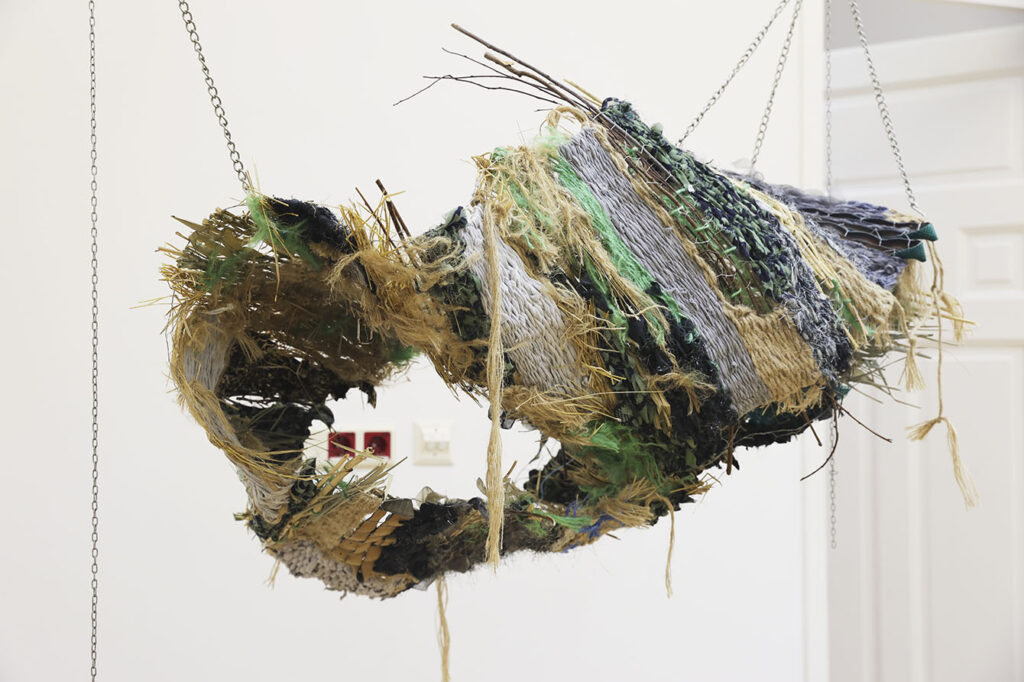
Artist: Pille-Riin Jaik
Title: Proposal for a landscape (a nonorientable surface)
Proposal for a landscape is a woven experimental textile in the form of a loop, suspended from two chains. The piece is made from found objects—among them straw, branches, ropes, and plastic waste—combined with second-hand materials, including textiles torn into strips and belts. All elements are interwoven, creating a continuous surface that folds into itself.
Disorientation

The outside flows into the inside, and the inside flows into the outside, forming one continuous surface. As a result, this unique form (the Möbius strip) dissolves the distinction between inside and outside. Furthermore, it questions fixed categories, creating a never-ending flow of materials. In consequence, this structure produces a sense of disorientation—there is no single correct point of view, end or beginning, material hierarchy, or clear function.
Weaving a nest out of waste
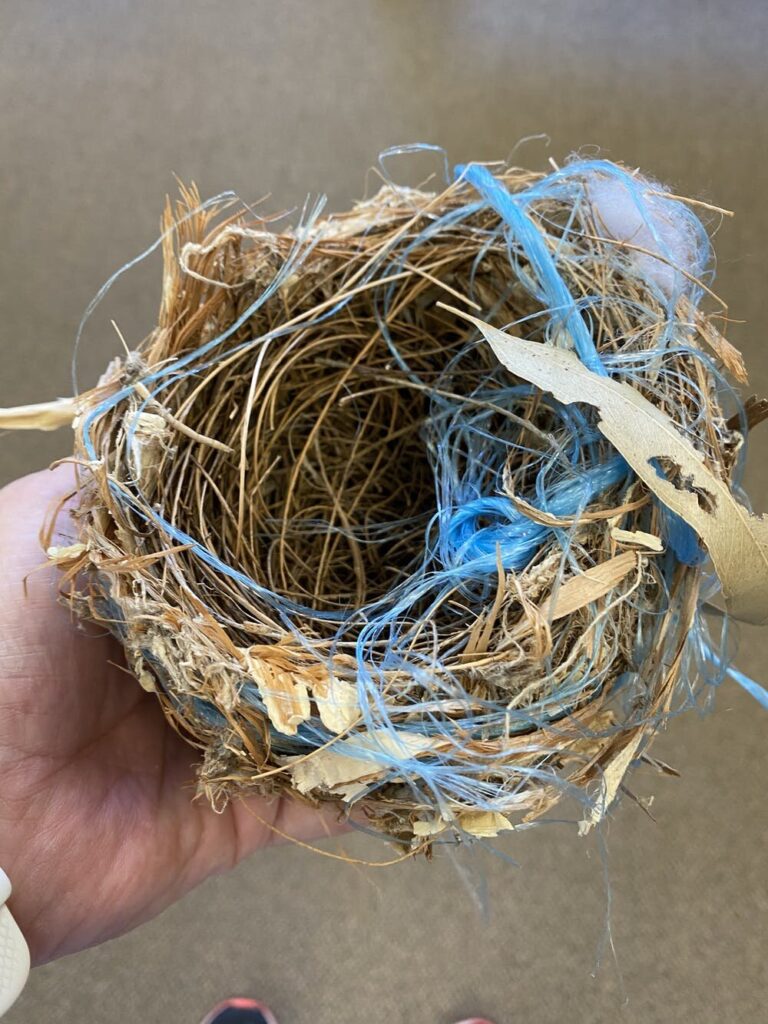
The structure resembles a bird’s nest and evokes associations with parental care. This nurturing attention is evident in how all materials, both natural and artificial, were treated, soaking the installation in tenderness.
Moreover, the weaving process is slow and meditative, and traditionally associated with women’s work. As such, it stands in tension with capitalist logics that privilege speed, efficiency, and productivity. Instead, Pille-Riin fosters embodied attention1 and an intimate engagement with material.
Today, due to human expansion, more and more animals incorporate human trash into their nests. Consequently, this observation can evoke feelings of guilt and loss—and prompt reflection on the potential harm humans cause to ecosystems.
Enchanting matter
In this context, the artist collecting materials near the Lobau (a National Park in Austria) also resembles a bird building a nest, gathering both natural objects and discarded waste. 2
Did the artist choose them, or did the materials enchant her?

Here, the artist’s process meets Jane Bennet’s theory. In Vibrant Matter, Bennett presents matter not as passive, but as active. It’s endowed with its own agency. Furthermore, it can affect us physically, chemically, psychologically, and even spiritually. An object can both nourish and kill; it can provoke revulsion as much as delight.
This heightened sensitivity to the agency of so-called inanimate things recalls animism—the belief that all entities, human and nonhuman, possess a form of vitality or spirit. Such a perspective is not incidental in the context of the artist’s background: Estonia, a bastion of pre-Christian animistic traditions.
This spirituality of matter and entire landscapes, Jaik successfully translates into an undulating flow of materials suspended in space.
From Resource to Relation
Why does this matter?
By reframing matter as active rather than passive, the artist challenges us to engage with it more attentively, carefully, and ethically. By contrast, when matter is treated merely as a resource to be exploited, it contributes to ecological destruction and threatens planetary existence. Instead, Pille-Riin encourages a more sustainable and caring approach—not only to nature in general, but to materiality itself.
Michał Rutz
- Human attention is not merely a mental process, but one deeply intertwined with bodily actions. Embodied attention emphasizes that our physical presence—including posture, hand movements, and gaze—shapes how we perceive the world. ↩︎
- “Stadtfarm in Vienna can, with its beautiful lushness of nature reservoir between gray heavily trafficked highways, leave one often with the feeling of vertigo. The crossing entanglements and unexpected patterns provide a constant of interrelated growths,” Pille-Riin Jaik, “Proposal for a Landscape: A Nonorientable Surface,” accessed May 6, 2026, https://pilleriinjaik.com/works/proposal-for-a-landscape-a-nonorientable-surface/ ↩︎