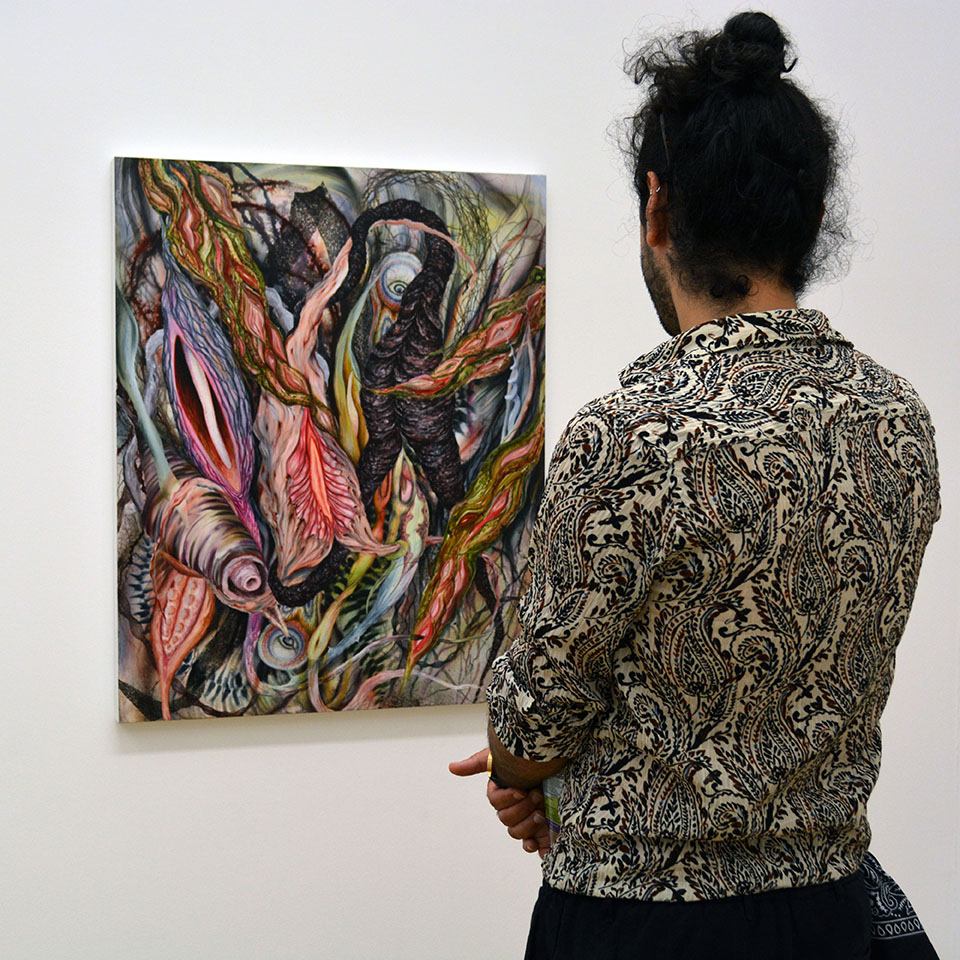
Paweł Matyszewski, Biological Composition 19
acrylic and oil on canvas, 2025.
This work was created for the exhibition “Imagining Queer Utopia” at Queer Museum Vienna and is part of it.
Curator: Michał Rutz
Tentacles and slits
The canvas is overrun with an amalgam of queer forms that slip away from fixed categories. Undulating lines and organic shapes evoke hair, entrails, tentacles, and vines twisting and bending in a convulsive rhythm. These forms are often incised with numerous openings and slits, resembling wounds, mouths, buttocks, and reproductive organs. They intertwine and caress one another, creating a fleshy, pulsating carpet.
It is impossible to separate them from one another; it is equally difficult to determine the nature of their relationship—whether it is symbiotic, parasitic, or whether we are confronted with a single organism, an ecosystem dependent on each of its elements. This uncanny entanglement evokes ambivalent feelings—ranging from disgust to fascination with the richness of textures, forms, and lines.
Monstrous flower-vulva
The center of the composition occupies a light pink, fleshy form composed almost entirely of an opening and wriggling tentacles. The opening evokes a hybrid—a gaping flower-vulva. On the right side, opposite it, an “inverted,” dark, wrinkled form appears, resembling buttocks; instead of a torso and legs, it possesses tentacles.
The flower-vulva reminds me of a monologue by Slavoj Žižek from the film The Pervert’s Guide to Cinema.
My relationship toward tulips is inherently lyrical. I think they are disgusting. Just imagine—are these some kind of, how do you call it, vagina dentata? A dental vagina, threatening to swallow you.
I think that flowers are something inherently disgusting. I mean, are people aware what a horrible thing these flowers are? Basically, it’s an open invitation to all—to all the insects and bees—come and screw me, you know?
I think that flowers should be forbidden to children.
For Žižek, flowers are not only obscene but also threatening; they provoke an ambivalence between attraction and repulsion, a tension that is central to Matyszewski’s painting as well.
In The Monstrous-Feminine, Creed shows that what provokes fear in patriarchal culture often centers on the female body, which is simultaneously seductive and dangerous. The motif of vagina dentata is a particularly vivid example of this dynamic.
Female agency and defiance, as well as the transgression of gender codes, are frequently portrayed as monstrous by normative society. This exhibition, however, seeks to invert that gaze: we show empathy and care toward what is normally deemed monstrous. Figures of monsters become metaphors for female and queer power, for rage and desire released from restrictive social norms, celebrating bodies that resist imposed limitations.
Penetration vs Circlusion
This figure resonates with Bini Adamczak’s groundbreaking concept of circlusion, which describes being penetrated as an active act rather than a passive one—as embracing, enveloping, or putting something onto something else. Adamczak illustrates the idea with the example of a bolt and nut:
[…]rotating a bolt into a nut is penetration; and rotating the nut onto the bolt, circlusion… Obviously, both processes are happening at the same time.
By complementing penetration (with a penis, dildo, finger, or tongue) with enveloping (with a mouth, anus, vagina, or hand), Adamczak proposes a new language of sexuality—one that challenges the heterosexual logic that equates penetration with dominance and agency, and being penetrated with submission and passivity. This logic is often reproduced even within queer communities through top/bottom dynamics. Adamczak’s goal is not to critique domination or penetration, but to nuance these categories and expand the possibilities of erotic imagination.
In this context, the flower-vulva appears as an active, agentive body—one that decides for itself.
Androgynous Hybrids
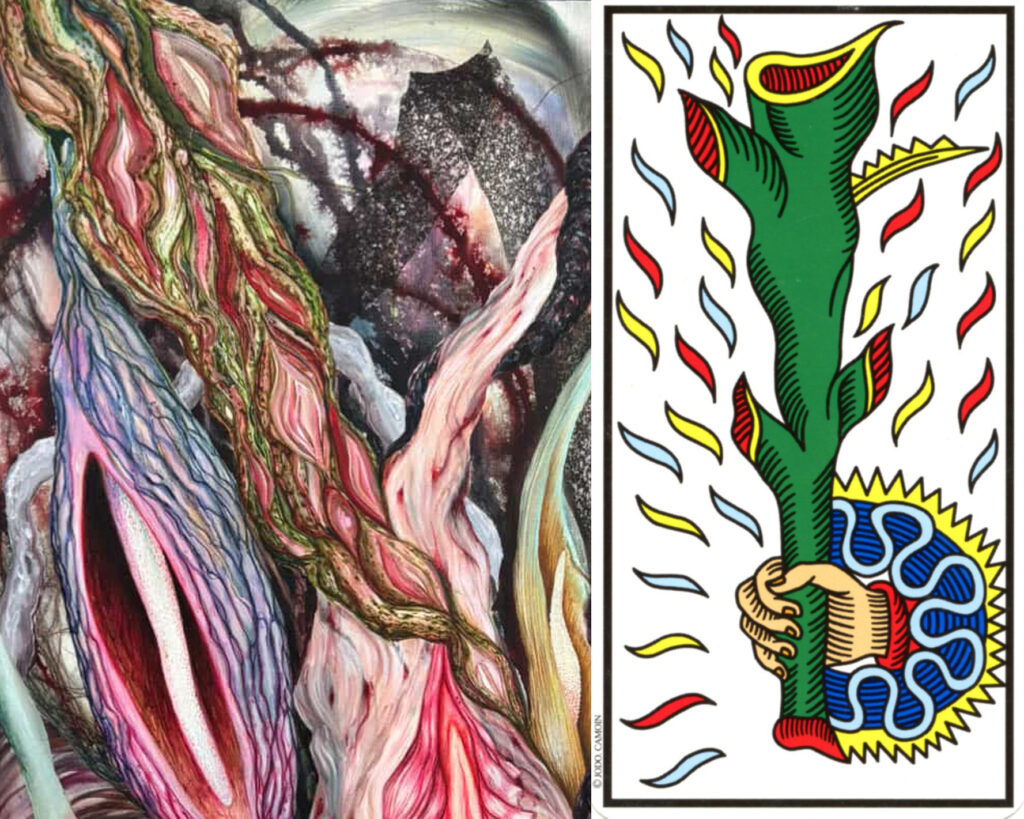
Right: Ace of wands from the Tarot de Marseille
The logic of dissolving binaries extends beyond the central form. Three green tentacles invade the canvas—one from the upper left corner and two from the right. They are reminiscent of the Ace of Clubs from the Tarot de Marseille. On the card, the tip of the phallic club is crowned with a vulva-like shape, as is each severed branch.
Similarly, the green tentacles in the painting are full of slits, evoking analogous imagery. In both cases, protrusions and hollows, red and green, phallic forms and openings are combined to create androgynous, hybrid forms. Most, if not all, of the elements in the painting seem to follow this logic.
Kinky Speculations

The painting evokes associations with nineteenth-century botanical atlases, particularly the illustrations of Ernst Haeckel. Yet instead of pursuing scientific classification, Matyszewski follows imagination, kinking off the rational path toward speculative evolution.
The artist constructs fantastical visions of reproduction, drawing strategies from both the animal and plant worlds to create a hybrid language of reproduction. Openings and phalluses of all kinds lure potential lovers or victims—or perhaps make no distinction between these categories at all.
Unruly Bodies and Desires
Plants, fungi, and other hybrid beings evoke unruly bodies and undisciplined desires that challenge heteronormative and fascist fantasies of purity. There is no head, no center, no hierarchy; no clear subject and no distinct boundaries between what is alive and what is dead.
This multiplicity generates an affective surplus that precedes interpretation—before the mind can organize the image into neat, separate categories. In this way, Matyszewski questions identity not only as a cultural or social construct but also on a more fundamental, corporeal level, where the body appears as an amalgam of beings, materials, environment, and processes—an assemblage, rather than an autonomous, self-contained whole.
Michał Rutz