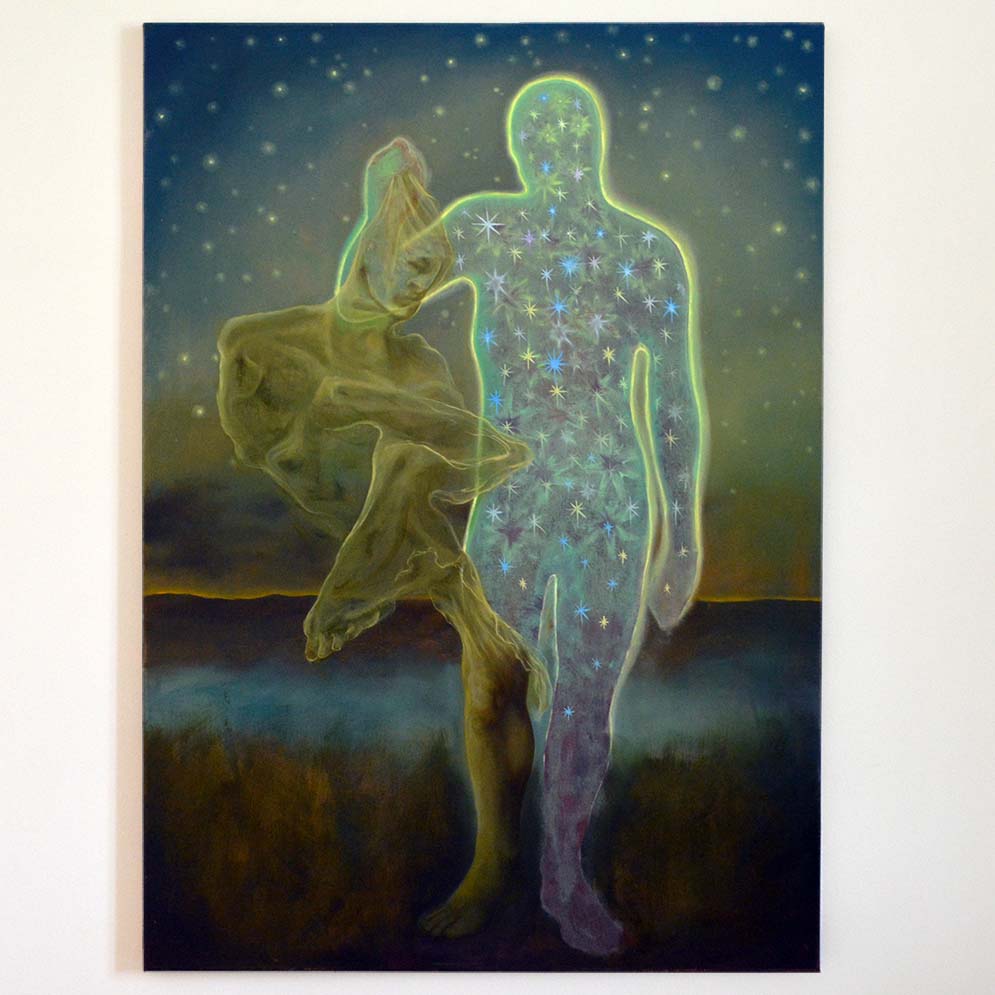
Artist: Krzysztof Gil, Stardust
oil on canvas, 2025
This work was created for the exhibition “Imagining Queer Utopia” at Queer Museum Vienna and is part of it.
Curator: Michał Rutz
Celestial stripper
A solitary human figure removes its own skin, revealing not organs but a luminous silhouette shimmering with dozens of stars. It is spectral, immaterial, and sexless. A radiant outline sharply separates it from its surroundings, while a halo spreads around the figure—belonging to the rising sun behind it—which, like a stage spotlight, focuses attention on the celestial stripper.
Body as a temple
The being stands against a star-filled sky. Paradoxically, the stars on its body are larger, more beautiful, and more decorative than those surrounding it. They shimmer with white, yellow, and blue lights against the aquamarine of the body. As a result, they do not create an illusion of a real sky, but rather an ornamental surface that evokes Gothic star-painted vaults, such as those in the presbytery of St. Mary’s Basilica in Kraków, where the artist lives and works.
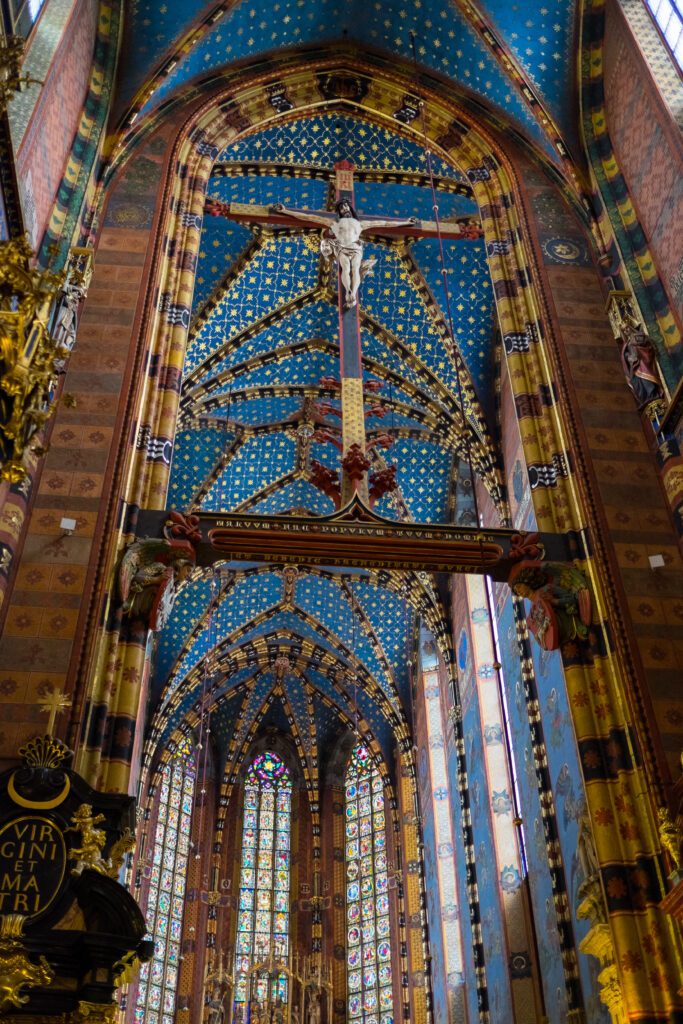
In traditional theological readings, the walls, pillars, and columns of the church, along with their earthy palette, symbolize the material human world, while the blue vaults refer to the spiritual and transcendent realm. This resemblance is particularly evident in the first version of the painting.
Celestial matter
The figure, whose body appears as “celestial matter,” combines elements of corporeality and transcendence. It is no longer confined to earthly materiality nor to a purely spiritual realm; instead, it exists in an intermediate, hybrid state that exceeds traditional binary categories: male–female, white–black, body–spirit. Drawing on the ideas of the French philosopher Georges Bataille, spiritual experience can be embodied, and bodily experience spiritual. Sensuality and spirituality aren’t opposed—they bleed into each other.1
Skin as a symbol of martyrdom
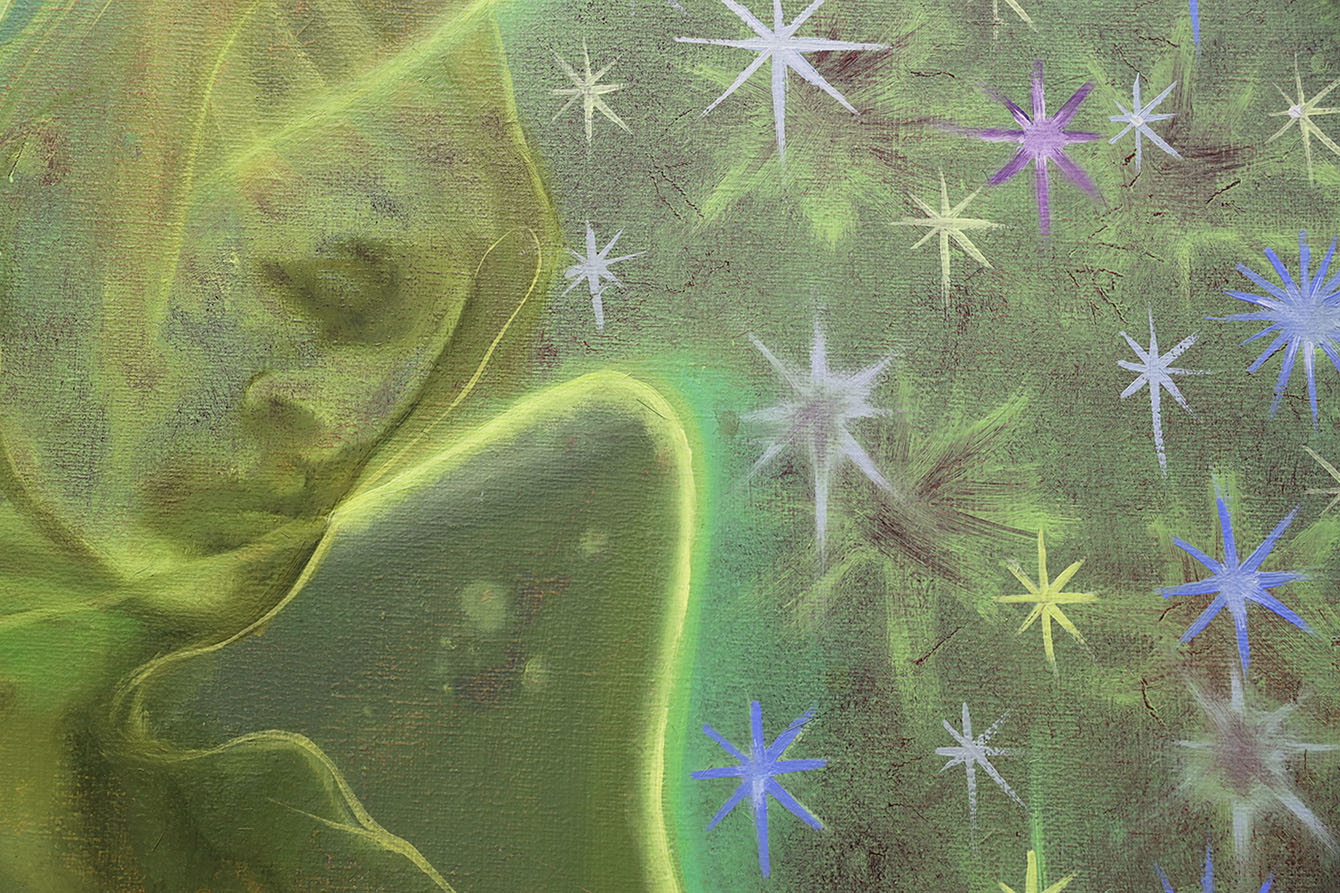
Only the calf remains corporeal. The process is nearly complete. With the rising sun, a new beginning is announced.
The rest of the skin—brownish-green—flutters in the raised hand. Displayed almost like a trophy, like the pelt stripped from a slain animal. Deformed. Wrinkled. The scene recalls the figure of Saint Bartholomew from Michelangelo’s Last Judgment. This reference points to skin as a symbol of martyrdom—of suffering—particularly in the context of discrimination based on skin color.
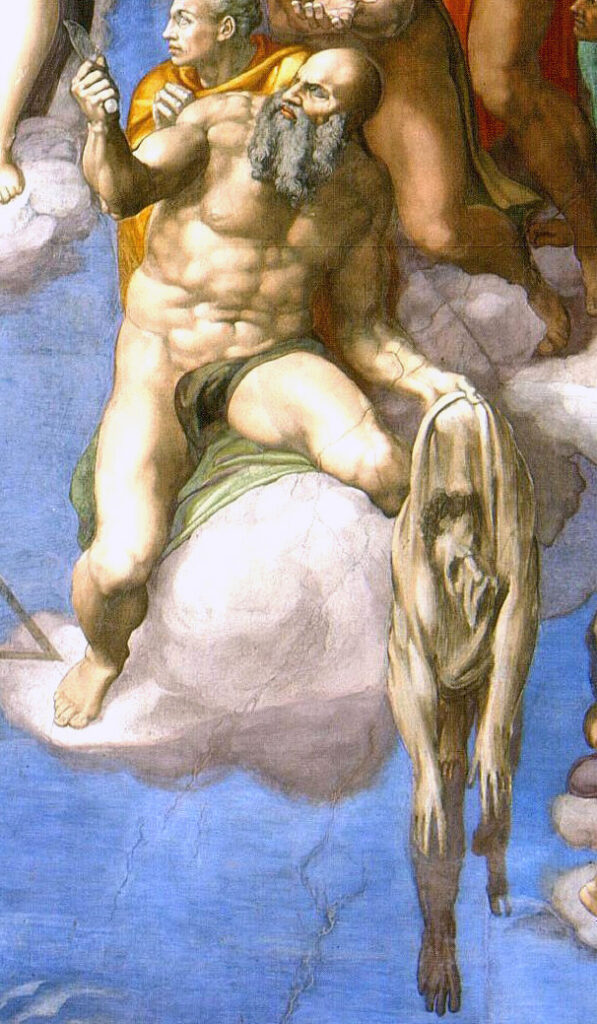
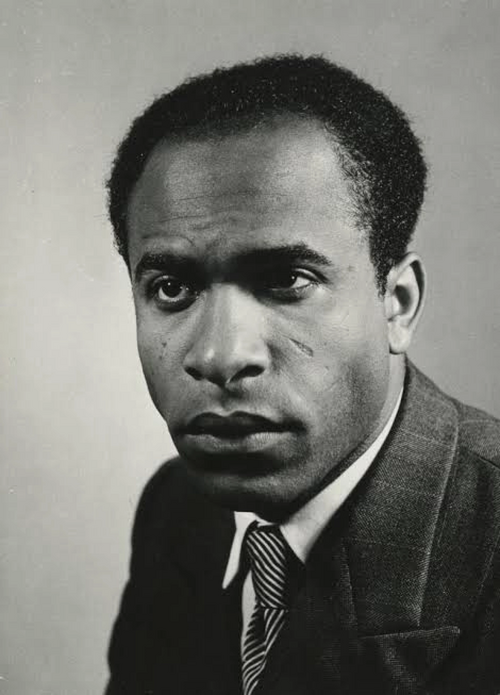
Right: Photograph of Frantz Fanon from Black Skin White Masks (1967)
The othering gaze
In Black Skin, White Masks, Frantz Fanon describes one of his first experiences of being seen as Black. The dark skin color—a neutral fact in his native Martinique—becomes in France something that defines him. The situation he recounts occurs when a child points at him and cries:
“Look, a Negro!”
“Mama, see the Negro! I’m frightened!”
Fanon experiences othering and objectification: his body ceases to be neutral. It becomes an object defined by the gaze of the other and the projections of racial fantasies.
“I was responsible at the same time for my body, for my race, for my ancestors. I subjected myself to an objective examination; I discovered my blackness, my ethnic characteristics.”2
This account can easily be translated into other contexts of stigmatization, in which a subject is similarly defined by the othering gaze. The exclamation “Look, a Negro!” finds its counterparts in phrases such as “Look, a Gypsy!” or “Look, a fag!3”—moments in which someone’s difference is publicly named, and the individual is reduced to labels and stereotypes charged with negative feelings and exclusion. This identity is not self-determined but imposed from outside, transforming the skin into a surface onto which social anxieties are projected.
The painting expresses a desire to strip away the identities imposed by the gaze of others. In this way, the scene can be understood as a reversal of the othering process: the figure in the painting acts autonomously and voluntarily. Instead of causing pain, it frees itself from it. The figure no longer has a face or any fixed identity traits. In this anonymity, the work reflects the theme of liberation from social and cultural constraints—of gender, orientation, race, and ego.
The fluid-self
This motive of identity dissolution evokes the practice of Big Sky Meditation, popularized in the West by Joseph Goldstein4, which I have personally practiced. Goldstein uses the metaphor of stars in the sky to describe the nature of sensations—both internal and external. He encourages perceiving these sensory impulses like stars: unconnected, flickering only to vanish moments later, making way for new sparks in the vast sky of awareness. As concentration deepens, the habitual perception of the body as a “solid” object begins to dissolve. Instead of experiencing a limb or torso as discrete parts, the body appears as a fluid field of energy.
Radical Metamorphosis
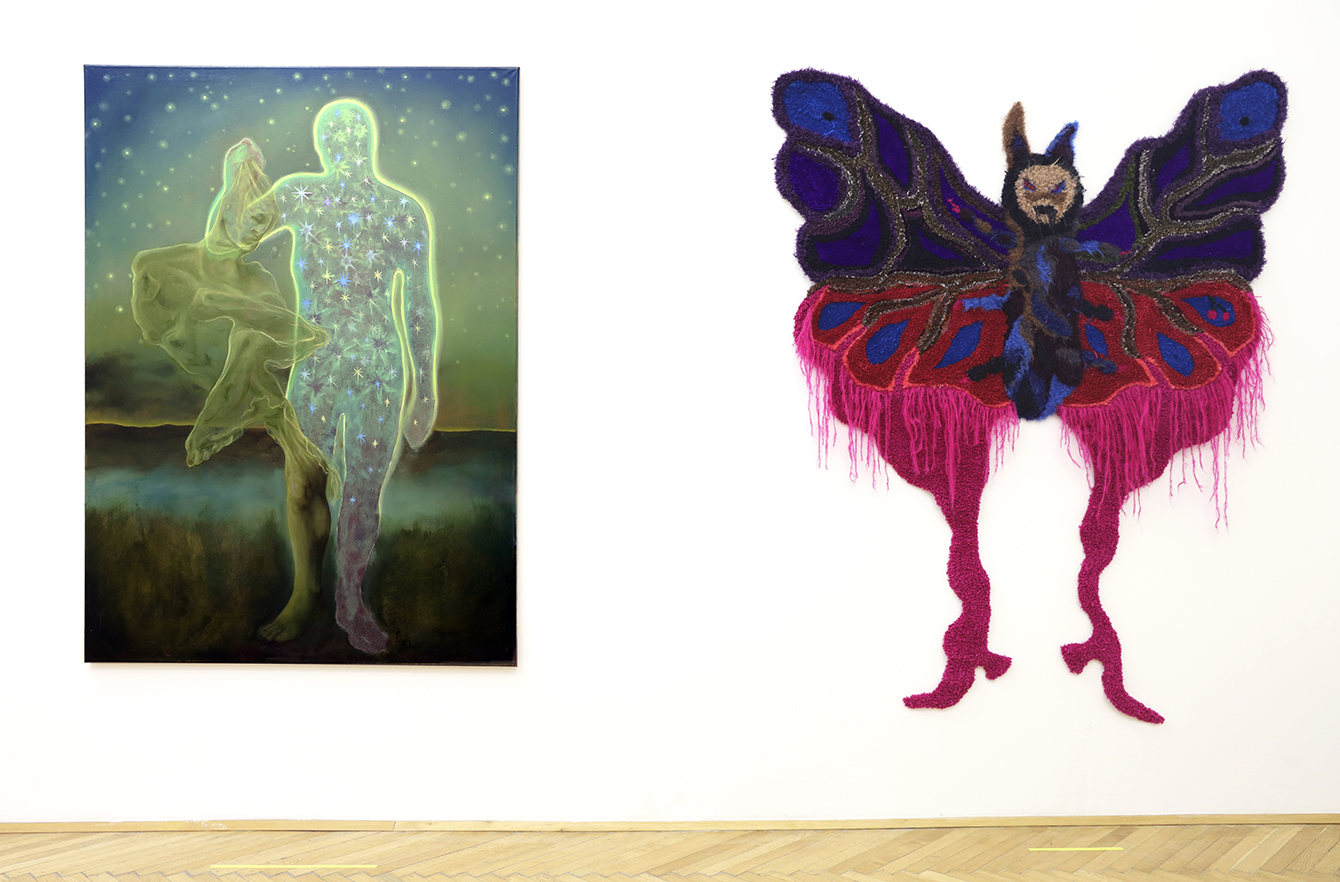
Photo: Larissa Kopp
Both works (Gil’s Stardust and Tuvshinbat’s Mother) are utopian fantasies of radical transformation unconstrained by imposed identities. Like a moth, the stripper sheds a layer of skin like a cocoon, revealing a new form.
Ornament as self-creation
Their bodies become ornamental surfaces. Normally, decoration is understood as something added on top, like stickers on a notebook, but these works suggest something different: the body itself can become the decoration. They call us to:
Adorn ourselves. Use rhinestones, makeup, drag, and pose.
To adorn yourself is to become your own fantasy.
That ‘adding things’ is not superficial; it is transformational. Ornament is an expression of inner life. It makes it visible. It’s a utopian desire for more.
Ornament as technology of transcendence
Ornament goes beyond self-expression. Throughout history, it has been used to make the divine visible—to mark bodies, objects, and spaces as extraordinary, beyond pure utility or function. In this sense, ornament becomes a technology of transcendence, marking the body (or object) as more-than-ordinary.
Both artists use ornamentation not simply to beautify the body or express inner life, but to present the body as more than a machine. Their work stands in opposition to looksmaxxing culture, which reduces the body to an empty shell while neglecting the vast sky of the inner world of sensations.
Instead, they go beyond the limits of what’s deemed as realistic and possible. Using ornamentation to reconnect the body to desire, imagination, and the sacred.
Michał Rutz
[The text underwent sensitivity reading by a person with lived experience relevant to the subject matter discussed in the text.]
- Georges Bataille, Eroticism: Death and Sensuality, trans. Mary Dalwood (San Francisco: City Lights Books, 1986). ↩︎
- Frantz Fanon, Black Skin, White Masks, trans. Charles Lam Markmann (New York: Grove Press, 1967), 84. ↩︎
- The author is aware that queerness is not synonymous with race and that, unlike skin color, it can remain invisible or hidden. At the same time, its visible elements often manifest in the body—in behavior, mannerisms, voice, movement, or fashion. In moments when queerness is called out, queer individuals, like Fanon in the experience he describes, begin to scrutinize their own bodies, gestures, and ways of being, internalizing the external gaze and subjecting themselves to a process of continuous self-surveillance. ↩︎
- Daniel Goleman and Richard J. Davidson, Altered Traits: Science Reveals How Meditation Changes Your Mind, Brain, and Body (New York: Avery, 2017). ↩︎