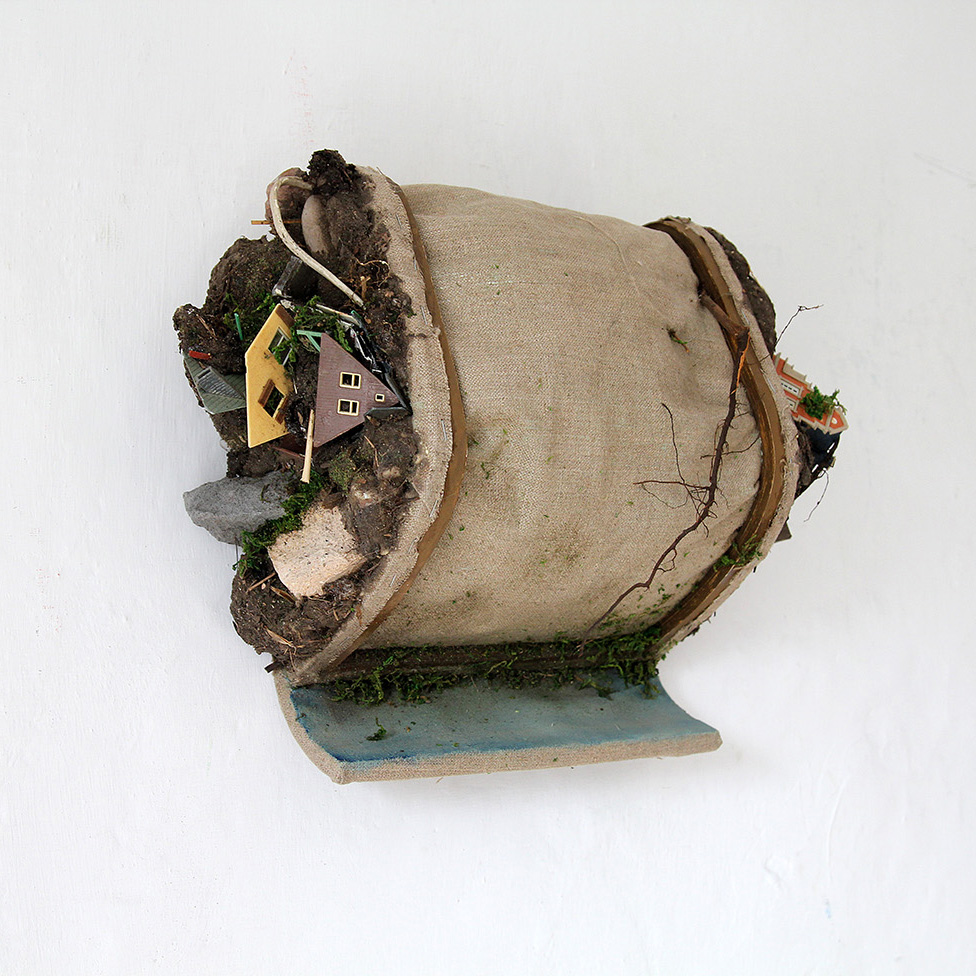
Artist: Bartosz Kokosiński,
Painting Devouring Rural Landscape
artist’s own technique, 2025
This artwork is part of the exhibition Imagining Queer Utopia, curated by me (Michał Rutz) at Queer Museum Vienna.
Camp Hetero-Apocalypse
The image literally bends and twists, devouring the heteronormative order — single-family houses. These seemingly neutral architectural forms carry a specific ideology: the model of nuclear family, private property, and inheritance. Their destruction can be read in the spirit of Jack Halberstam’s concept of “unlearning, unbuilding” — as a conscious rejection of normative structures. In their place emerges the potential for a new architecture: one open to alternative forms of kinship, relationships, and community, which are yet to unfold.

The object may also be read as a playful take on the classical motif of the destruction of Sodom and Gomorrah. In the traditional biblical interpretation, the destruction of the cities functions as punishment for queerness: God annihilates the cities of sin to reaffirm divine order. Similarly, many fascist fantasies idealize a return to traditional family structures and simpler rural living, while demonizing cities as sources of depravity. Kokosiński reverses this narrative by replacing the city with the village: it is not queerness that is annihilated, but the normative world itself.
A specter of Revolution
What is this force that warps, overturns, and shatters the established order? It can be understood as an assemblage of hunger, rage, and defiance — a desire that slips beyond reason and social control. It devours and digests them into disorder.
Desire is not attributed to any particular being or subject. It operates as an external force, as affect that flows between bodies and social structures, enveloping entire communities. It can take both reactionary and revolutionary forms. In this sense, it is no coincidence that Marx described communism as a spirit—the specter hovering over Europe.
Deformation and Disordering as a Method
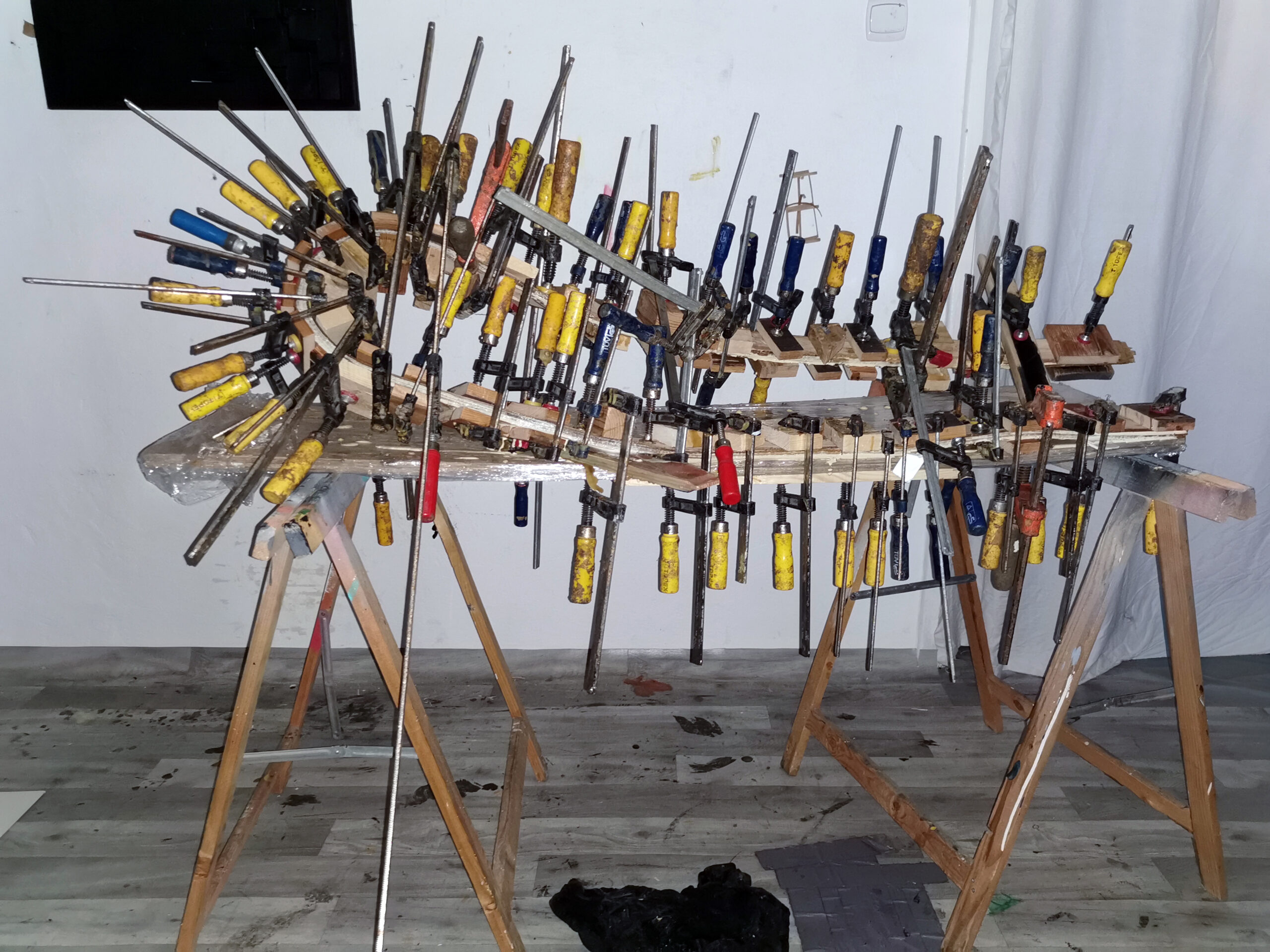
Perverse tendencies in Kokosiński’s work reveal themselves as a conscious reversal of the logic of correction and normalization. Instead of straightening and ordering, the artist deforms, folds, and twists. The process of deformation itself is very delicate and slow. The artist gradually increases pressure on the wooden stretcher using massive metal clamps. This process may evoke sadomasochistic practices, understood as relations based on control rather than violence, in which the body is gently pushed toward its limits and pain serves to intensify pleasure. The canvas becomes a field of perverse labor: a site where the violence of norms is reversed, and deformation — rather than error — functions as a method.
Queering the Image
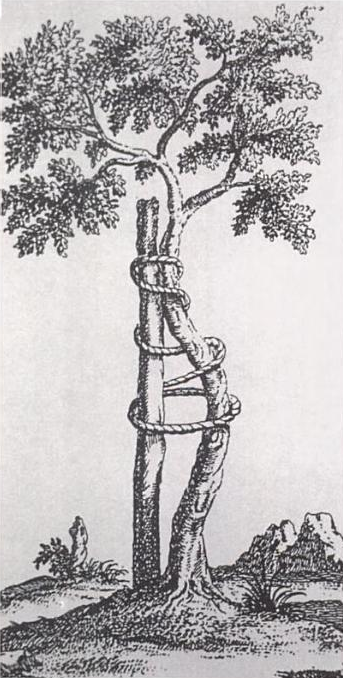
Kokosiński’s cycle Paintings Devouring Reality breaks the traditional structure of the canvas by refusing to remain flat, ordered, or visually obedient. Rather than presenting a stable image, the surfaces bulge, fold, and twist, dismantling the familiar hierarchy of frame, surface, and representation. The works disorient the viewer, destabilizing categories of front and back, interior and exterior, and the boundary between painting and sculpture. They cease to function as pictures meant merely to be looked at and instead operate as physical bodies in their own right — unruly organisms asserting their own modes of existence.
Michał Rutz